One calendar for everyone at home. No accounts.
A private home for family life.
One shared calendar and to-do list for everyone at home — with per-person colours, repeating events, reminders that actually arrive, and invites you can email to people who don’t use the app. No accounts, encrypted end to end.
Free · works offline · installs like an app · nothing to sign up for.
What it does
Built for the way a household actually runs
-
Everyone’s week, in one place
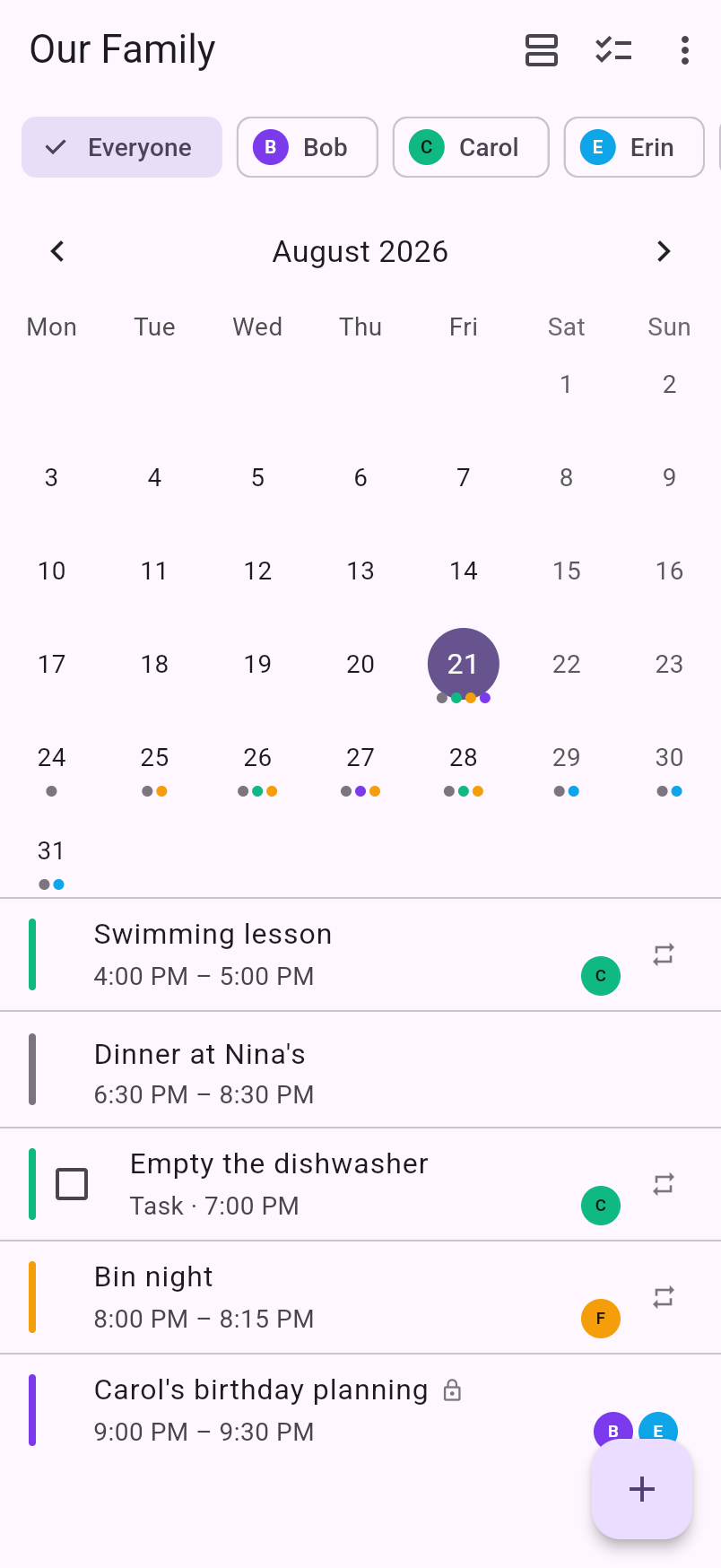
A month grid to see where things sit, an agenda to see what’s next. Each person has their own colour and a short badge, so a day reads at a glance even when four people have something on.
-
Tasks live on the calendar too
A chore isn’t an event — but “what’s on Tuesday” is one question, and answering half of it means the other half gets forgotten. Tasks dot their day like anything else, with a checkbox where the difference belongs.
-
Repeating events, done properly
A whole series is one entry, so swimming every Tuesday doesn’t clutter anything. Move or cancel a single week and the rest of the series carries on untouched — even after that occurrence has been shifted.
-
Reminders that actually arrive
A web app can’t keep its own alarm clock, so the server keeps a list of times and wakes your phone — with an empty message. Your device decrypts and writes the notification itself. Tasks keep reminding you until they’re ticked off; events don’t nag.
-
Email an invite to anyone
Send an event to somebody who doesn’t use the app and it lands in their own calendar — Apple, Google, Outlook. Edits update the entry they already have instead of adding a second one. Off until the whole family turns it on.
-
Private means unreadable, not hidden
Mark an entry private and it’s encrypted to exactly the people it’s for, under a key nobody else in the family holds. Not a setting the app agrees to respect — a document the other devices genuinely cannot open.
-
A person, not a user account
A kid with no phone is still on the calendar. People and devices are separate things: you add the person, and whoever picks up a phone says which person they are.
-
No account, no email, no password
A 24-word recovery phrase is the whole identity. Everything is encrypted on your device before it syncs, it works offline, and it installs like a normal app.
Reminders & email
Two things a private calendar usually can’t do
A calendar nobody is reminded by is a diary, and one that can’t tell a grandparent about Sunday is a wall chart. Family Manager does both — and because both involve someone other than your own device, both are explained in full rather than mentioned in passing.
How it works
Encrypted, without accounts
- 1
One recovery phrase
On first use, Family Manager generates a 24-word recovery phrase. Those words are your identity — there's no account, username, or password behind them.
- 2
The phrase unlocks your keystore
The phrase derives a master key that encrypts a small personal keystore — the list of shared spaces you belong to and the key for each.
- 3
Each shared space has its own key
A family has one group key. Everything in it is stored as documents encrypted with that key. Sharing the space means sharing that one key — via a QR code or invite — and the space's owners decide who's in. Remove someone and the key is rotated and re-shared to everyone who remains, so they see nothing new.
- 4
A blind server just relays ciphertext
Your devices sync through a server that stores and forwards encrypted blobs and pushes live updates. It never holds a key, so it cannot read anything it syncs.
Security
Even the sync server can’t read it
- One recovery phrase 24 BIP39 words derives your master key
- Master key encrypts your keystore the list of spaces you belong to
- Group key encrypts one space's documents every event, encrypted
Stores & relays encrypted blobs. Fans out live updates. Cannot decrypt anything.
Why it’s different
Private by design
-
End-to-end encrypted
Encryption and decryption happen only on your devices. Plaintext never leaves the device.
-
The server is blind
It's untrusted infrastructure by design: it stores and relays ciphertext and never holds a key. Compromising the server leaks nothing readable.
-
No accounts, nothing to breach
No email, no password, no profile. There's no user database to leak — just anonymous encrypted blobs keyed by hashes.
-
Open source
The apps, the encryption core, and the server are all public. Inspect the crypto or self-host the server — you don't have to take our word for it.
-
Standard, modern crypto
libsodium primitives (XChaCha20-Poly1305, BLAKE2b) and BIP39 phrases. No custom cryptography.
-
Works offline
A PWA with a local encrypted cache — it works without a connection and syncs when it's back.
The Mycelium
One private foundation, a family of apps
The Mycelium is a small family of apps that all share the same promise — no accounts, end-to-end encrypted, and open source. Set up once and the same private identity works across every one of them.
 Next Dose Track medication doses for yourself or the people you care for. Visit Next Dose →
  Tally Stick Split shared expenses for trips, housemates or couples. Visit Tally Stick →
  Stock Level Know how many days of anything you have left — feed, cereal, kibble. Visit Stock Level →
  Family Manager You’re here One shared calendar and to-do list for everyone at home.
  Rep Sheet Log workouts — treadmill, weights, plank, pilates — and watch them add up. Visit Rep Sheet →
  The MyceliumAll 5 in one app
Don’t want five icons on your home screen? The Mycelium is every
app above in a single install, sharing one recovery phrase — named for the
fungal network that links separate trees underground and lets them share.
Visit themycelium.au →
The MyceliumAll 5 in one app
Don’t want five icons on your home screen? The Mycelium is every
app above in a single install, sharing one recovery phrase — named for the
fungal network that links separate trees underground and lets them share.
Visit themycelium.au → Start using Family Manager
No sign-up, no email, no password. Open it and go — your data is encrypted before it leaves your device.